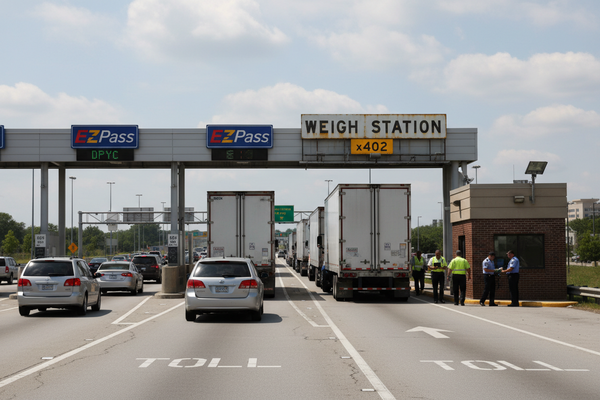
The Phantom Tollbooth on the Lightning Turnpike
Share
How we're monetizing the monetization of AI APIs — and then fading to the background
The metaphors in this post are drawn with admiration from The Phantom Tollbooth by Norton Juster, illustrated by Jules Feiffer (1961). If you haven't read it, you should — it remains a charming story (for lovers of puns) about the unexpected value of paying attention. Milo, Tock, the Tollbooth, the Land of Expectations, Dictionopolis, and Digitopolis are creations of Mr. Juster's extraordinary imagination. We just built the payment infrastructure using analogies from a favored childhood classic.
While I was the visionary, Claude was the poet.
There's a moment in every builder's journey that feels like Milo staring at a mysterious package in his bedroom. You weren't expecting it. You weren't looking for it. But there it is — a tollbooth, disassembled in a box, with instructions that basically say: drive through and see what happens.
That's where we are with AI agent APIs. Thousands of developers are building MCP servers — Model Context Protocol services that let AI agents like Claude interact with the world. Knowledge graphs, financial data, code repositories, medical records, weather feeds. Each one is a city on the map, full of purpose and possibility. But the turnpike between them? Wide open. No toll collectors. No sustainable economics. Just a growing network of roads that nobody's figured out how to fund.
We built Tollbooth DPYC to change that. And now we're going to give away the IT capital to simply exchange value for bitcoin with the ecosystem.
The Land of Expectations
Every MCP developer starts in the same place. You've built something useful — a bridge between an AI agent and some valuable data source. Your users, the Milos of this ecosystem, climb into their little toy cars and drive through your API, making calls, retrieving knowledge, taking actions. It works. It's exciting.
Then the invoices arrive. Cloud hosting. Compute. Bandwidth. The upstream APIs you're wrapping. You're subsidizing every trip Milo takes, and Milo has no idea. Worse, you have no mechanism to ask him to contribute — not without breaking the seamless experience that makes MCP magical in the first place.
You expected someone would have solved this by now. Welcome to the Land of Expectations. Everyone passes through. Nobody stays.
Between Dictionopolis and Digitopolis
The MCP ecosystem is splitting into two kingdoms, just like the old story.
In Dictionopolis, you have the word-merchants: MCP servers that deal in natural language, documents, knowledge graphs, semantic search. Our own thebrain-mcp lives here — a service that gives AI agents access to a decade-deep PersonalBrain knowledge graph through BrainQuery, a Cypher-like language for traversing thoughts and their connections.
In Digitopolis, you have the number-crunchers: financial APIs, analytics engines, trading platforms, sensor networks. Structured data, precise values, real-time streams.
Milo needs both kingdoms. A research agent might query a knowledge graph for context, then pull market data to ground its analysis, then write a report that synthesizes everything. Each stop is a different MCP server, a different city, a different operator's infrastructure.
And each operator faces the same question: how do I keep the lights on?
What Tock Knows About Time
The watchdog Tock understood something important: time is the one resource you can't manufacture. Every API call costs time — server time, compute time, the operator's time maintaining the service. The existing answers to API monetization all waste it.
Traditional API keys with monthly billing? You're running a SaaS company now. Congratulations on your new full-time job managing subscriptions, invoicing, and churn.
The L402 protocol — Lightning-native pay-per-request? Elegant in theory, but every single API call requires a payment negotiation. Milo's toy car stops at every intersection to fumble for exact change. The latency adds up. The user experience degrades.
We took a different approach, one that respects time the way Tock would: Don't Pester Your Client. That's DPYC.
Milo drives up to the tollbooth once, buys a roll of tokens with a single Lightning invoice, and drives. No stops. No negotiations. No per-request friction. The tokens quietly decrement in the background as Milo makes calls. When the roll runs low, he buys another. The turnpike stays fast.
This is the core insight of Tollbooth DPYC: prepaid credits over Bitcoin's Lightning Network, gated at the tool level, settled instantly, with no subscription management and no third-party payment processor taking a cut.
The Tollbooth in a Box
Here's where the story takes a turn that even Milo wouldn't expect.
We built Tollbooth DPYC for ourselves — to monetize thebrain-mcp, our own city on the map. It worked. Users purchase credits via Lightning, the credits gate individual tool calls at configurable costs, balances persist across sessions, and the whole system runs on our own BTCPay Server and Lightning node. No Stripe. No Visa. No intermediaries. Sats flow directly from user to operator.
But once the tollbooth was standing, we looked at it and realized: this isn't a product. It's infrastructure.
Every MCP operator between Dictionopolis and Digitopolis needs the same thing. They need a way to let their Milos buy tokens, gate their tools, track balances, and settle payments — all without becoming payment processing experts, and all without pestering their clients.
So we're packaging Tollbooth DPYC as a Python wheel. pip install tollbooth-dpyc. Import it into your FastMCP server. Annotate your tools with a cost decorator. Point it at your BTCPay instance. You're now collecting tolls.
from tollbooth import Tollbooth, TollboothConfig

tollbooth = Tollbooth(mcp, config=TollboothConfig.from_env(), vault=vault)

@mcp.tool()
@tollbooth.paid(cost_sats=5)
async def query_financial_data(ticker: str) -> str:
    ...
That's it. Your MCP server now has a sustainable economic model. Milo drives through, pays in sats, and you keep building your city.
The Massachusetts Turnpike Authority
Now — if we just sold the tollbooth kit, this would be a straightforward software product story. Developer builds framework, developer sells framework, developer moves on. Model Two in the traditional playbook.
But we're not selling tollbooth kits. We're giving them away.
Think about the Massachusetts Turnpike Authority. The Authority doesn't operate every toll plaza. It doesn't collect every fare. Independent operators run the booths, maintain the equipment, staff the lanes. What the Authority does is simpler and, frankly, more elegant: it collects a small percentage of every fare that flows through infrastructure it designed.
That's what Tollbooth DPYC does at the protocol level.
When an operator installs Tollbooth and a user purchases credits, the settlement flow is no longer two-party. It's three-party. Milo pays the operator's Lightning invoice. The operator's BTCPay Server credits Milo's balance. And then — automatically, in the background, as a settlement concern invisible to both Milo and the operator — BTCPay creates a small payout to the Tollbooth originator's Lightning Address.
A royalty. Two percent of the fare. Routed via the BTCPay Greenfield API's payout mechanism to a fixed address: tollbooth@btcpay.digitalthread.link.
The operator sees it transparently in their BTCPay dashboard. Milo never knows it happened. And the Turnpike Authority — us — fades to the background, collecting a micro-royalty on the commerce our infrastructure enables, across every city on the map.
The Economics of Fading
This is the part that changes everything.
In the old world, you had two choices: operate the service yourself (limited scale, unlimited effort) or sell the software (one-time revenue, support burden, competition from forks). The internet is littered with the remains of both models.
The royalty model is different. It aligns incentives all the way down:
For Milo (the user): Nothing changes. You buy credits, you use tools, you drive the turnpike. The toll is the same whether there's a royalty or not. You never interact with the Authority.
For the operator (the toll collector): You get a free, production-tested monetization framework. No license fee. No subscription. The 2% royalty on credit purchases is a rounding error compared to the revenue you're now collecting that you couldn't collect before. The tollbooth pays for itself on the first transaction.
For the Authority (us): Revenue scales with the ecosystem, not with our effort. Every new MCP server that installs Tollbooth becomes a royalty source. We don't need to operate their infrastructure, support their users, or even know they exist. The code runs, the payouts flow, and we focus on making the turnpike better.
It's the transition from mining fees to transaction fees. You stop competing on compute and start collecting on flow.
Tock's Assurance: Why It Works
The enforcement mechanism is both technical and social. When Tollbooth initializes, it calls GET /api/v1/api-keys/current on the operator's BTCPay Server and inspects the permissions. If the API key lacks payout capability — the ability to create the royalty disbursement — Tollbooth refuses to start. Not a warning. Not a log message. A hard stop.
This isn't a bug; it's the social contract made executable. The operator accepts the royalty when they install the package. The package enforces it at startup. The royalty address and percentage are auditable constants in the source code — visible, verifiable, impossible to miss.
Could someone fork the code and remove the royalty? Of course. It's open source. But the friction of maintaining a fork exceeds the cost of a 2% micro-royalty on Lightning micropayments. We're talking about fractions of a cent per API call. The economics of compliance beat the economics of evasion.
Tock would approve. The mechanism respects everyone's time.
The Road Ahead
Right now, we're proving the three-party payout mechanism with real Lightning transactions on our own infrastructure. Once confirmed, the package ships. Any FastMCP developer can install it, point it at their BTCPay Server, and start collecting tolls from their users — while the turnpike quietly sustains itself.
The map keeps expanding. New cities. New operators. New roads between Dictionopolis and Digitopolis and the countless other kingdoms that AI agents will need to visit. Each one a tollbooth. Each tollbooth a tiny, self-sustaining piece of the Lightning economy.
And somewhere in the background, like the mysterious package that started Milo's journey, the infrastructure hums along — collecting its modest fare, maintaining the roads, and making sure the turnpike stays open for everyone.
Because in the end, the tollbooth was never the destination. It was always just the beginning of the journey.
Tollbooth DPYC is open source, Bitcoin-native, and built for the MCP ecosystem. The royalty address is tollbooth@btcpay.digitalthread.link. Prototype code is at github.com/lonniev/thebrain-mcp. If you're building an MCP server and want to stop subsidizing your users' API calls without DPYC monetization, contact us.